Background:
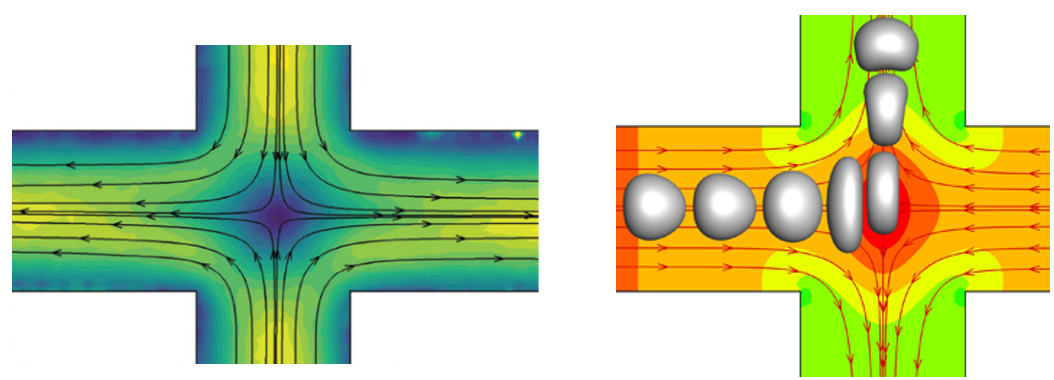
Microfluidic cross-slot geometries generate strong extensional flows (See Fig. 1 (left) ), making them ideal for investigating viscoelastic fluid behavior. Numerical studies have demonstrated their effectiveness for comparing constitutive models in such flows [1],[2]. Additionally, research showed that droplet breakup in cross-slot devices can serve as a powerful tool for extensional rheometry, highlighting the potential of using particle deformation as an indirect probe for fluid properties [3].
When a deformable elastic particle is introduced, the fluid’s elastic stresses and the particle’s elasticity interact in complex ways, affecting both particle deformation and migration (See Fig. 1 (right) ). Understanding these interactions is crucial for lab-on-chip applications, soft matter physics, and microrheology-based sensing.
Figure 1. Extensional velocity profile [2] (left), deformation of a deformable particle [4] (right) inside a cross-slot geometry.
Project objective and approach
The goal of this project is to numerically study how an elastic particle (modeled as a Neo-Hookean solid) deforms in a viscoelastic fluid in a cross-slot geometry. To this end we will use an inhouse Finite Element code (TFEM). Specifically, we will study the effect of:
Weissenberg number (Wi): ratio of fluid relaxation time to flow time scale.
Elasticity ratio: ratio of particle elasticity to fluid elasticity.
The particle will be placed near the stagnation point of the cross-slot flow, where extensional stresses are strongest. By systematically varying these parameters, we aim to identify trends in particle deformation and assess whether these trends can be linked to fluid rheology.
References
[1] Puangkird et al., J. Non-Newtonian Fluid Mech., 2009
[2] Yokokoji et al., Soft Matter, 2024
[3] Marshall & Walker, Rheologica Acta, 2019
[4] Lu et al., J. Fluid Mech., 2023