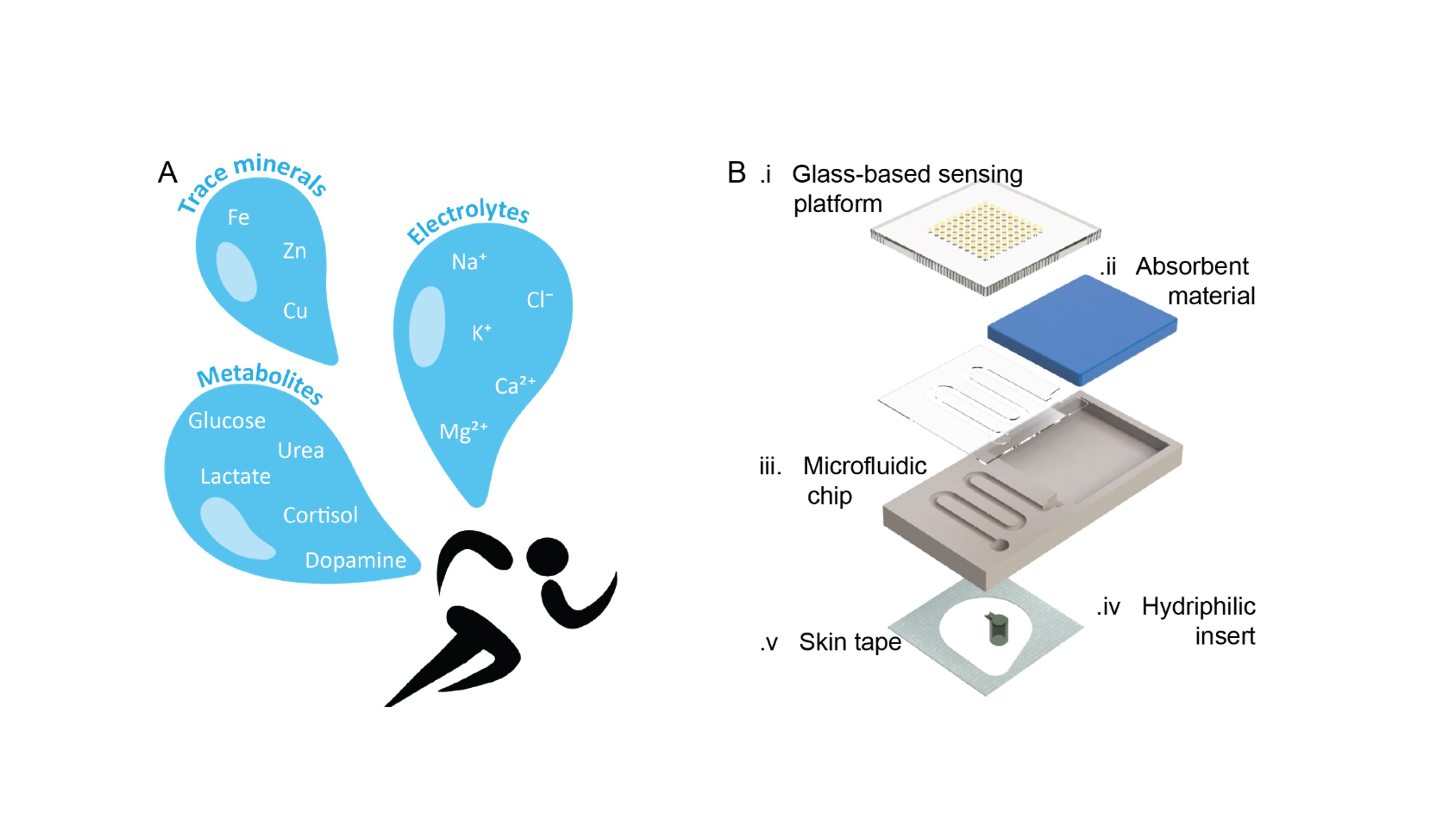
Introduction: Continuous monitoring of biomarkers in athletes’ sweat has emerged as a powerful tool for optimizing athletic performance, preventing injuries, and enabling personalized training strategies (Fig. 1A). For accurate sweat-based biomonitoring, sweat rate is a critical parameter, as it varies widely between athletes and during the same exercise. Measuring sweat rate allows biomarker concentrations to be correctly normalized to the total sweat volume produced, significantly improving data reliability [1].
Project goal: We have already developed and validated a microfluidic chip capable of continuous, in vivo sweat collection (Fig 1B). The goal of this project is to design the next-generation by integrating a sweat volume and sweat-rate tracking module.
The concept relies on a passive pump: sweat fills a reservoir of fixed volume, which empties once full through contact with an absorbent material (Fig 1C). Each emptying event is detected by a pair of electrodes, enabling real-time measurement of total sweat volume and sweat rate [2].
Main objectives:
Identify the most appropriate electrical parameter that can be measured between a pair of electrodes to clearly distinguish between full and empty reservoir states.
Design the electrode platform and the amplification circuitry to maximize the signal difference between the two states.
Fabricate the electrodes using multiple fabrication techniques and systematically compare their performance.
Perform in vitro testing to measure continuous sweat rates in the range of 0.1–10 μL/min up to several hours.
Validate the fully integrated system in vivo during real exercise conditions.
Impact: This project offers hands-on experience across multiple phases of the technology development cycle while working on a highly innovative concept that could be applied for patenting in the next future.
You will work in the MicroFab Lab, equipped with state-of-the-art microfabrication and cleanroom facilities. You will be part of the Microsystems section, an international and multidisciplinary research group with expertise spanning from neuromorphic engineering to organ-on-chip systems.
Motivated and curious students are encouraged to apply. If you are interested, please contact t.bo@tue.nl for more information or to propose your own ideas regarding biomonitoring of athletes.
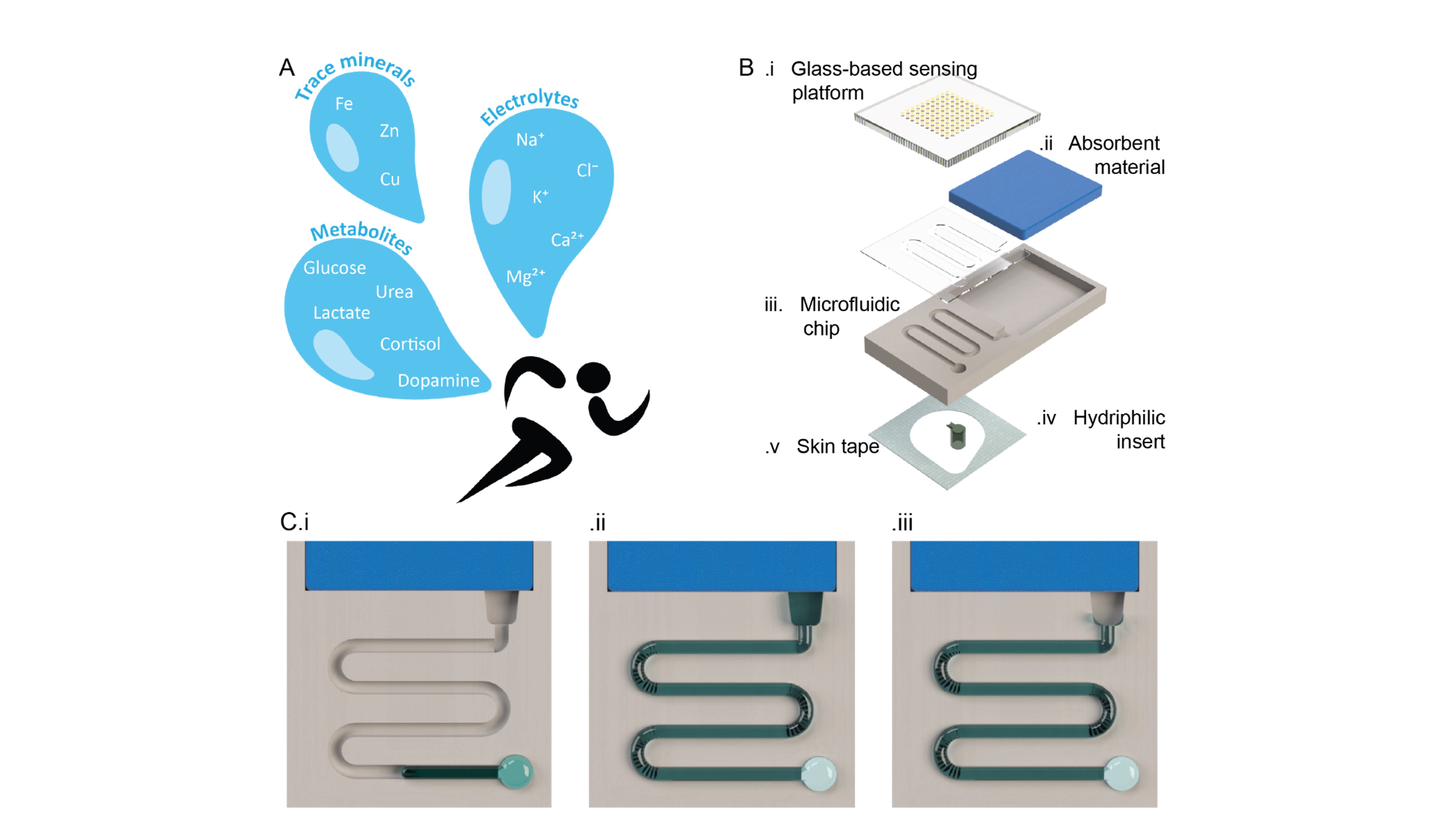
Figure 1. A - Schematic of the typical biomarkers present in the sweat of athletes. B - 3D rendering of the first generation of the microfluidic chip, comprising: i – the glass based sensing platform, ii – the absorbent material used as the passive pump of the sweat tracking system, iii – the microfluidic chip with iv- the hydrophilic insert to facilitate sweat collection and v - the skin tape to seal the device to the skin. C - Schematic of the sweat-tracking system operation: i - sweat enters through the inlet and fills the microchannel, ii - sweat fills also the reservoir, iii - once the reservoir is completely filled, sweat comes into contact with the absorbent material, which acts as a passive pump and removes sweat from the reservoir.
References
[1] Davis et al. (2024), Nat Biotechnol.
[2] Moonen et al. (2024), Lab Chip.